Mayumiotero – Discovering Calligraphy can begin with something as ordinary as writing a name on paper. However, the experience quickly becomes different from everyday handwriting. Each line requires attention to shape, pressure, spacing, and rhythm. As a result, letters become more than tools for communication. They become visual elements that can express personality and style. Calligraphy also offers an interesting contrast to modern digital habits. Most messages today are typed within seconds. A handwritten letter, meanwhile, develops one stroke at a time. That slower process is part of its appeal. You do not need to become a professional artist to appreciate it. A simple pen, suitable paper, and curiosity are enough to begin exploring how ordinary letters can gradually become art.
Read Also: NVIDIA Invests in MediaTek as AI Chip Competition Intensifies
Calligraphy Is More Than Beautiful Handwriting
Calligraphy is often described simply as beautiful handwriting. Yet that definition does not tell the whole story. In practice, calligraphy involves creating letters through deliberate strokes and controlled movements. The relationship between thick and thin lines can be important, depending on the style and tool. Spacing also influences the final composition. Therefore, a calligrapher thinks about both individual letters and the way those letters work together. Regular handwriting usually prioritizes speed and readability. Calligraphy, on the other hand, gives more attention to form and visual rhythm. This distinction explains why someone with ordinary handwriting can still learn calligraphy. The goal is not to transform everyday handwriting into something perfect. Instead, the process involves learning a different way to construct letters.
A Long Artistic Tradition Continues to Evolve
Calligraphy has developed across many cultures rather than belonging to one single tradition. Latin-script calligraphy evolved through handwritten manuscripts and changing writing styles in Europe. Meanwhile, Arabic, Chinese, Japanese, Persian, and other calligraphic traditions developed their own tools, aesthetics, and cultural meanings. These traditions should not be treated as interchangeable because each has a distinct history. Modern calligraphy adds another layer to this broad story. Today, artists often experiment with traditional principles while creating more flexible letterforms. Some compositions are elegant and structured. Others appear playful, minimal, or highly expressive. Consequently, Discovering Calligraphy can also become an introduction to the remarkable variety found within written art.
Modern Calligraphy Gives Beginners Room to Experiment
Traditional calligraphy styles may follow detailed rules for letter proportions, angles, and strokes. Modern calligraphy is often more flexible. This makes it approachable for people who want a creative hobby without immediately mastering a formal script. Beginners can experiment with letter size, spacing, flourishes, and composition. Nevertheless, freedom does not mean technique becomes irrelevant. Basic stroke control still helps create cleaner and more consistent letters. In fact, learning a few fundamentals can make experimentation more enjoyable. Once the basic movements feel comfortable, personal style can develop naturally. This balance between structure and freedom is one reason modern calligraphy fits well within a Creative Lifestyle. It encourages skill development while leaving space for individual expression.
Simple Tools Are Enough to Begin Practicing
Starting calligraphy does not require a desk filled with expensive supplies. A brush pen and smooth practice paper can be enough for a beginner. Brush pens are convenient because the ink is already stored inside the pen. Their flexible tips also allow line width to change with pressure. Dip pens offer another experience. They use a nib that is dipped into ink, which can provide greater control for certain scripts. However, they may require more practice. Pencils are useful as well, especially when planning layouts or practicing basic shapes. Therefore, beginners can start small and add tools only when their interests become clearer. In my view, this approach is more useful than buying a large kit before understanding which style feels enjoyable.
Basic Strokes Build the Foundation of Better Letters
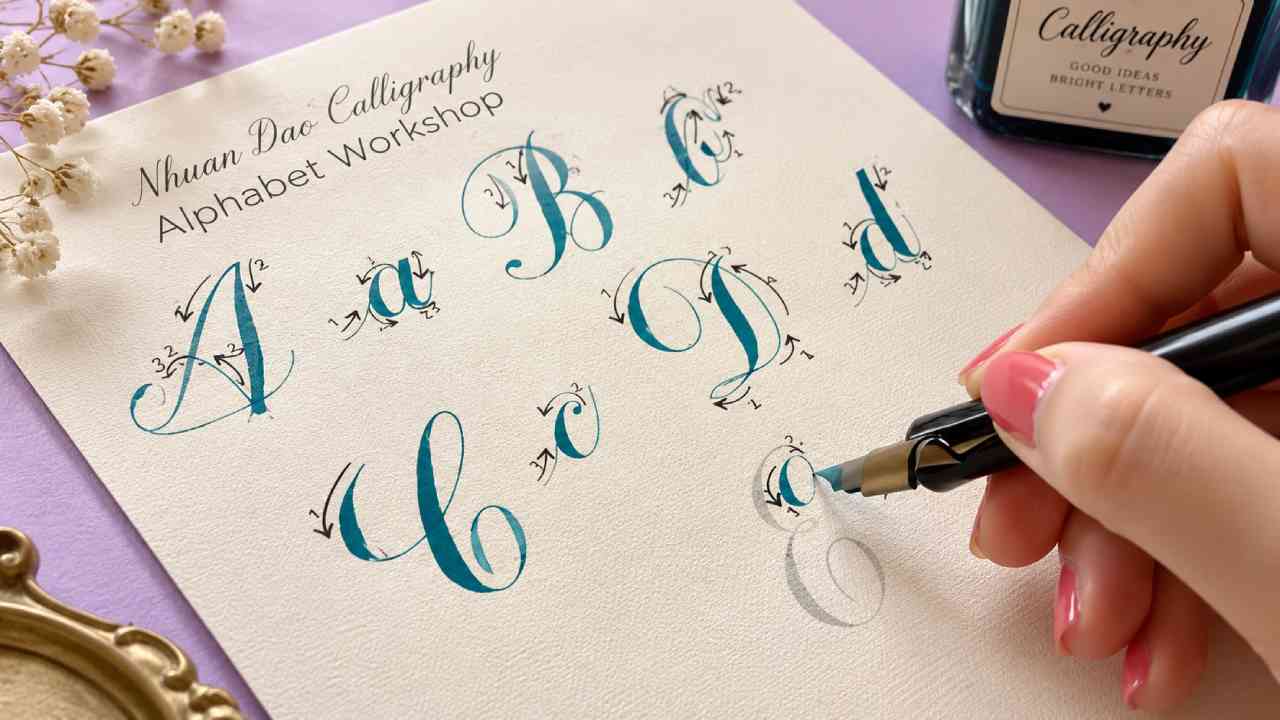
Beginners often want to start by writing complete words. However, practicing basic strokes first can make the learning process easier. Many calligraphy styles build letters from repeated movements. Curves, loops, entrance strokes, and downward lines appear again and again. With a flexible brush pen, upward movements are commonly made with lighter pressure. Downward strokes often use more pressure to create thicker lines. At first, this coordination may feel unusual. The hand has to learn when to relax and when to apply pressure. Over time, repeated movements can become more controlled. Therefore, a page filled with simple lines may be more useful than it looks. Those basic exercises gradually prepare the hand for more complex letterforms.
Imperfect Lines Are Part of Learning Calligraphy
A first calligraphy practice sheet rarely looks like a polished social media post. Lines may shake. Letter spacing may appear inconsistent. Some curves may look smooth, while others feel awkward. This is normal when learning a manual skill. More importantly, those imperfections provide useful information. A shaky downward stroke may reveal inconsistent pressure. Crowded letters may show that spacing needs more attention. Instead of hiding early attempts, keeping them can make progress easier to notice. After several weeks of regular practice, comparing old and new pages can reveal subtle improvements. From a Creative Lifestyle perspective, this is one of the most satisfying parts of Discovering Calligraphy. Progress becomes visible on paper rather than existing only as an abstract feeling.
Calligraphy and Hand Lettering Have Different Approaches
Calligraphy and hand lettering often appear together, so the terms are sometimes used as if they mean the same thing. However, their processes can differ. Calligraphy generally creates letterforms through intentional strokes made with a writing tool. Hand lettering is often described as drawing or illustrating letters. A lettering artist may sketch a word, adjust its proportions, erase sections, and refine the final design. In contrast, many calligraphy techniques depend more directly on the movement of the pen. Still, the boundaries can overlap in contemporary creative work. An artist might use calligraphy for the original word and then add illustrated details around it. Understanding the distinction is useful, but creative practice does not always need rigid categories.
A Few Minutes of Practice Can Become a Creative Ritual
One attractive feature of calligraphy is that practice does not need to occupy an entire afternoon. A short session can fit into an ordinary routine. For example, someone might spend ten or fifteen minutes practicing strokes after work. Another person may write one quotation in a journal during the weekend. Because the setup can be simple, calligraphy works well as a small creative ritual. Moreover, progress usually comes from repetition rather than one very long session. Regular practice gives the hand more opportunities to become familiar with the movements. This makes calligraphy suitable for people who enjoy creative activities but have limited free time.
Calligraphy Can Become Part of Everyday Creative Projects
Once basic skills develop, calligraphy can move beyond practice sheets. Handwritten lettering can appear on greeting cards, journal covers, gift tags, bookmarks, invitations, or small pieces of wall art. It can also complement watercolor painting, scrapbooking, photography, and other paper crafts. As a result, one creative hobby can connect naturally with several others. Personal projects also remove some of the pressure to produce flawless work. A handmade birthday card does not need to resemble a professional commission. Its value often comes from the fact that someone took the time to create it. This personal quality helps explain why handwritten elements continue to feel distinctive even when digital fonts can reproduce countless styles instantly.
Read Also: How Spatial Light Modulators Turn Light Into a Programmable Tool
Digital Tools Have Not Made Handwritten Art Irrelevant
Digital design offers speed, precision, and convenience. Thousands of typefaces can be tested within seconds, and mistakes can disappear with an undo command. Calligraphy provides almost the opposite experience. Ink cannot always be removed. Pressure changes in real time, and small variations remain visible. Interestingly, these differences can make handmade work feel more personal. Digital technology has also created new possibilities rather than simply replacing calligraphy. Artists can scan handwritten pieces, refine them digitally, or use tablets to explore brush-style lettering. Therefore, analog and digital methods do not need to compete. They can support different stages of the same creative process.
Discovering Calligraphy Can Help Shape a Personal Style
Technical skill is only one part of the journey. As practice continues, personal preferences often become clearer. Some people prefer clean and minimal letters. Others enjoy dramatic flourishes, bold brush strokes, or playful compositions. Color can also influence the mood of a piece. Black ink may create a classic appearance, while colorful brush pens can make the same words feel informal and energetic. Inspiration can come from historical scripts, contemporary artists, nature, architecture, or everyday typography. However, copying references should eventually lead toward experimentation rather than permanent imitation. Personal style usually develops through repeated choices. In that sense, calligraphy becomes a visual record of how someone’s creative taste changes over time.
Turning Letters Into Art Makes Calligraphy Worth Exploring
Discovering Calligraphy reveals how much creativity can exist inside something as familiar as the alphabet. A simple line can change with pressure. A word can gain personality through spacing, rhythm, and composition. Meanwhile, repeated practice gradually turns uncertain movements into more intentional strokes. The hobby can remain simple or grow into larger creative projects. It can stay entirely analog or become part of digital design. Most importantly, there is no requirement to produce perfect pages from the beginning. Calligraphy rewards observation, repetition, and curiosity. In a lifestyle increasingly shaped by fast digital interactions, creating letters slowly by hand offers a distinctly different creative experience. That contrast is exactly what continues to make this centuries-old art form relevant today.