Mayumiotero – Parametric Design transforms the creative process by turning relationships, rules, and adjustable values into tools for shaping objects and spaces. Instead of drawing every element separately, designers build a system that connects different parts of a model. Changing one value can then influence many related elements. For example, an architect might adjust the height of a roof while connected structural components respond automatically. This approach makes complex exploration faster and more controlled. Moreover, it encourages designers to think beyond a single fixed form. They can test several possibilities before choosing the strongest solution. Mathematics plays an important role, yet creativity remains essential. The computer follows relationships created by humans; it does not decide what makes a building beautiful or meaningful. Therefore, parametric thinking works best when technical logic supports a clear design purpose.
Read Also: Nvidia RTX Pro 6000 Price Soars to $16,000 as AI Memory Demand Tightens Supply
From Fixed Drawings to Flexible Design Systems
Traditional design often begins with a relatively fixed idea that develops through sketches, drawings, and models. Parametric Design, however, introduces another possibility. A designer can define relationships before committing to one final geometry. Imagine a facade made from hundreds of panels. Their width, depth, angle, and spacing might respond to several parameters. If the building dimensions change, connected panels can adapt without being individually redrawn. As a result, revisions become easier to explore. This flexibility is particularly useful during early design stages, when ideas may change frequently. Nevertheless, parametric methods do not eliminate traditional skills. Sketching, material knowledge, proportion, and spatial judgment remain valuable. In practice, the strongest workflow often combines intuitive thinking with computational tools. Technology provides flexibility, while human judgment determines which variation deserves to become reality.
Mathematics Can Produce Surprisingly Organic Forms
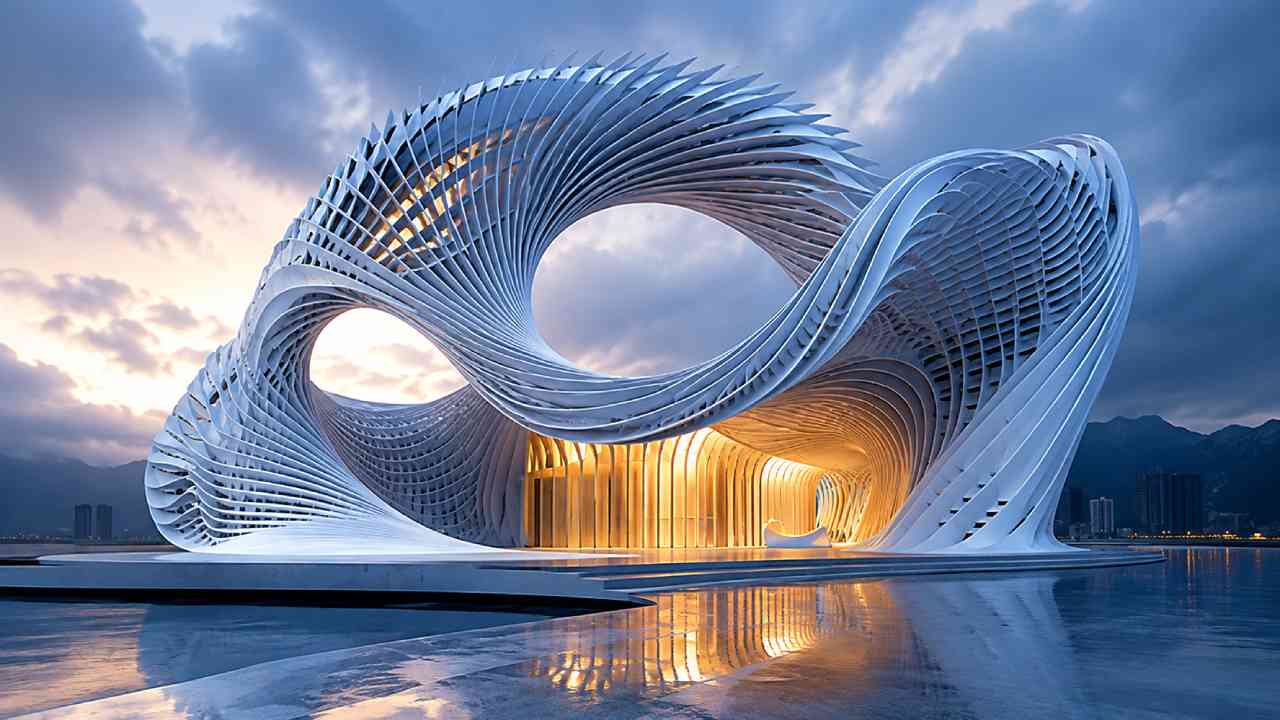
At first, mathematics may seem incompatible with the flowing shapes often associated with Parametric Design. In reality, mathematical relationships can create remarkably fluid geometry. Curves may change gradually according to numerical values. Repeating components can increase or decrease in size across a surface. Meanwhile, geometric relationships can control how a structure twists, expands, or contracts. These transformations often resemble patterns found in shells, leaves, waves, and other natural systems. However, organic appearance should not be confused with randomness. Behind an expressive surface may be a carefully structured network of rules. This contrast makes computational design visually fascinating. A building can appear spontaneous while its geometry remains highly controlled. Still, unusual forms should have a purpose. A spectacular curve adds limited value if it compromises circulation, comfort, construction, or long-term performance.
Architecture Is Only One Part of the Story
Architecture provides some of the most visible examples of Parametric Design, but the approach extends far beyond buildings. Furniture designers can use parameters to create benches that gradually change height along their length. Product designers may explore lightweight structures while controlling thickness and curvature. Jewelry designers can develop intricate patterns that would be difficult to draw individually. Likewise, interior designers can create ceiling systems, partitions, screens, and installations from families of related components. Digital fabrication expands these possibilities even further. CNC machines can cut many unique pieces directly from digital information. Meanwhile, additive manufacturing can produce geometries that would be difficult to achieve with conventional molds. Consequently, parametric thinking connects design with manufacturing in increasingly direct ways. The same digital logic that generates an object can also help describe how its individual components should be produced.
Responsive Facades Show Function Behind the Pattern
Decorative patterns may attract attention first, yet Parametric Design can also respond to environmental conditions. Consider a facade exposed to different amounts of sunlight throughout the day. Rather than giving every opening identical dimensions, designers can establish rules that change shading depth or aperture size according to solar exposure. Areas receiving intense sunlight may require stronger shading. Other sections can remain more open to support daylight and outward views. In this scenario, variation is connected to performance rather than decoration alone. Similar strategies can consider visibility, wind, structural forces, acoustics, or spatial requirements. However, computational output still requires evaluation. A digitally optimized pattern may create maintenance problems or unnecessary manufacturing costs. For that reason, performance data should inform design decisions without becoming the only measure of quality.
Parametric Furniture Turns Repetition Into Sculpture
Furniture offers a particularly accessible way to understand Parametric Design. Picture a wooden bench made from dozens of vertical sections. Each section differs slightly from the one beside it. Gradually, those changes create a smooth seat, backrest, and flowing silhouette. The finished object can resemble a sculpture, even though its geometry comes from a repeatable system. More importantly, parameters can control practical dimensions such as seat height, curvature, spacing, and material thickness. Designers can therefore adjust the overall shape while preserving important ergonomic relationships. Yet complexity must be justified. Hundreds of unique components may increase fabrication time, material waste, or assembly difficulty. A successful parametric furniture piece balances visual expression with comfort and manufacturing logic. In other words, computational complexity becomes valuable when it improves the object rather than merely making it look unusual.
Digital Fabrication Brings Complex Geometry Into Reality
Designing an intricate digital object is only half the challenge. Eventually, Parametric Design must become physical. Digital fabrication technologies have made that transition increasingly practical. CNC routers, laser cutters, robotic fabrication systems, and 3D printers can interpret digital geometry with high precision. As a result, designers can create families of components in which almost every piece is different. Each element can still belong to the same underlying system. This capability is sometimes described through the idea of mass customization. Instead of producing thousands of identical pieces, digital workflows can support controlled variation. However, fabrication constraints should enter the process early. Material dimensions, machine limitations, tolerances, joints, transportation, and assembly all influence what can actually be built. When these realities become parameters themselves, the digital model becomes more useful and reliable.
Parametric and Generative Design Are Not Identical
Although the terms sometimes appear together, Parametric Design and generative design are not exactly the same. A parametric model is primarily built around relationships and adjustable values. Change a parameter, and connected geometry responds according to established rules. Generative design often goes further by producing or evaluating many alternatives according to objectives and constraints. For instance, a system might explore numerous structural configurations while comparing material use or performance. The two approaches can also work together. A parametric model may provide the flexible framework from which alternatives are generated. Optimization tools can then evaluate those possibilities. Understanding this distinction is useful because it prevents every computational process from being placed under one label. Ultimately, both approaches expand the designer’s ability to explore options, but they organize that exploration in different ways.
Nature Offers Inspiration Without Needing Direct Imitation
Many Parametric Design projects appear inspired by nature because natural systems contain repetition, variation, hierarchy, and adaptation. Honeycombs, branching trees, shells, bones, and leaf structures all demonstrate how complex forms can emerge from underlying rules. Designers can study these principles without copying their appearance literally. For example, a branching system may inspire a structural network because loads need to move efficiently through several paths. A repeating cellular pattern might influence a lightweight screen. However, biomorphic appearance alone does not make a design efficient or sustainable. Nature-inspired geometry still needs engineering, testing, and appropriate material choices. This distinction is important because digital tools can produce convincing organic shapes very quickly. The challenge is to connect those shapes with meaningful performance or spatial qualities. When that happens, natural principles become more than visual references.
Read Also: Creative Wellness: Finding Balance Through Everyday Creativity
Parametric Design Can Support More Efficient Material Use
One promising application of Parametric Design involves material efficiency. Because dimensions and relationships can be adjusted systematically, designers can investigate where material is necessary and where it may be reduced. Structural analysis can also inform the geometry during development. For example, some components may become thicker where forces are greater and lighter where demands are lower. Fabrication layouts can likewise be studied to reduce offcuts from sheet materials. However, a parametric workflow does not automatically make a project sustainable. Complex geometry may require additional manufacturing energy, specialized materials, or difficult transportation. Therefore, environmental performance should be evaluated across the broader life cycle. The real advantage lies in the ability to test alternatives more systematically. When environmental goals become part of the design criteria, computational methods can help designers compare options before committing resources to construction.
Human Judgment Remains Essential Behind Every Algorithm
Powerful software can generate thousands of variations, but Parametric Design still depends on human decisions. Designers determine which variables matter, how they relate, and where limits should be placed. They also decide what counts as a successful outcome. A computer may calculate the most compact geometry, yet people must consider comfort, cultural context, accessibility, emotion, and beauty. These qualities cannot always be reduced to a single numerical score. Furthermore, poor assumptions can produce poor results even when the algorithm functions perfectly. For this reason, computational literacy should develop alongside traditional design knowledge. Understanding materials, construction, human behavior, and spatial experience remains crucial. The algorithm becomes most valuable when it extends a designer’s ability to think rather than replacing that thinking. In my view, this balance is what separates meaningful computational design from visual experimentation without purpose.
A Design Method Built for Exploration
The lasting appeal of Parametric Design comes from its ability to turn design into an adaptable system. A model can respond when dimensions change. Patterns can react to environmental information. Components can vary while remaining part of one coherent family. At the same time, digital fabrication can translate many of these variations into physical objects. Yet the method is not valuable simply because it produces futuristic curves. Its deeper strength lies in exploration. Designers can ask what happens when a rule changes, compare alternatives, and understand relationships that might otherwise remain hidden. Consequently, the final form becomes the outcome of an informed process rather than an isolated gesture. As architecture and manufacturing become increasingly connected with computation, parametric thinking will remain an important creative tool. The most compelling results will still come from combining digital precision with practical knowledge and human imagination.