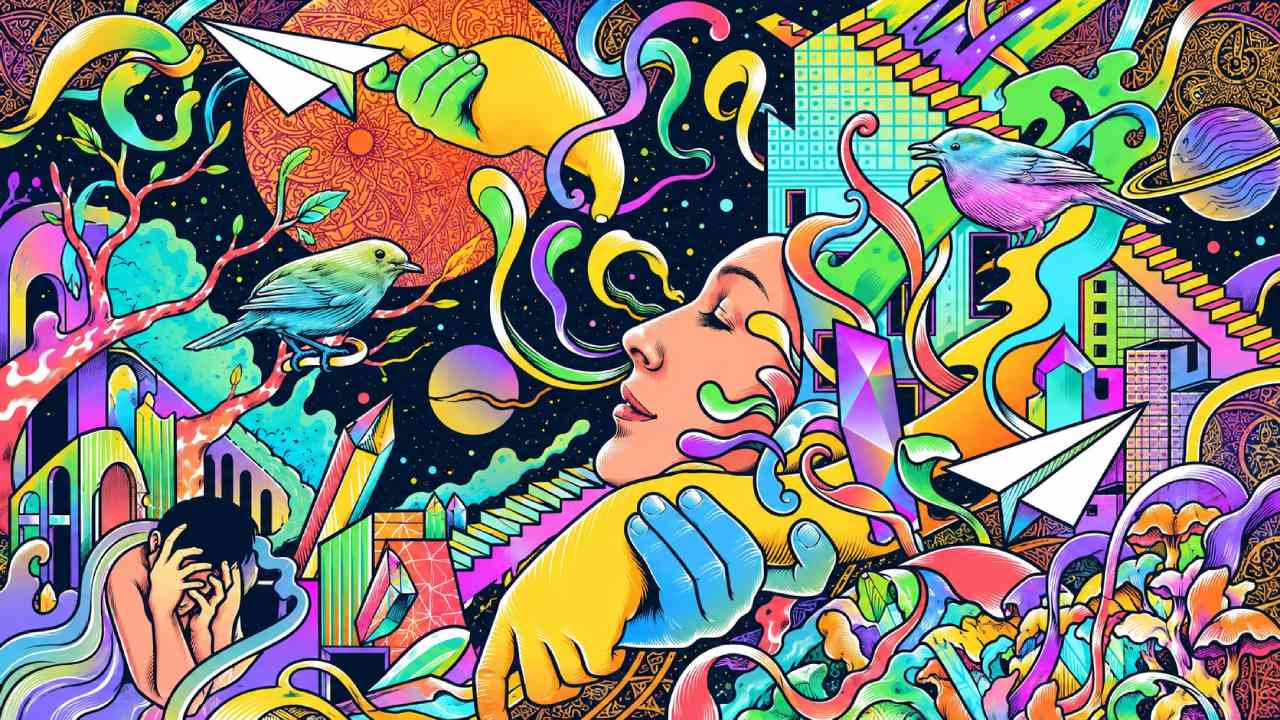
Mayumiotero – Psychedelic Design has returned to contemporary visual culture with an energetic mix of bold colors, flowing shapes, and surreal imagery. Although the style carries strong associations with the 1960s, today’s designers are giving it a distinctly modern identity. Digital tools make complex gradients, dimensional forms, and experimental compositions easier to explore. Meanwhile, brands and independent creators use these elements to stand apart from restrained visual trends. The result is an aesthetic that feels nostalgic without being trapped in the past. However, successful psychedelic work requires more than adding bright colors to a busy composition. Balance, hierarchy, typography, and purpose remain essential. Therefore, understanding where the movement came from helps explain why its expressive visual language continues to inspire modern creative work.
Read Also: Meta Business Agent Arrives in Indonesia, Bringing 24/7 AI Customer Service to Businesses
The Colorful Origins of Psychedelic Design
The history of Psychedelic Design is closely connected with the counterculture of the 1960s. During this period, music, art, fashion, and youth culture were changing rapidly. Designers responded with posters and album artwork that challenged established visual conventions. Flowing lettering, distorted illustrations, intense colors, and unusual compositions became recognizable features. In particular, concert posters provided fertile ground for experimentation because artists could abandon the strict layouts found in conventional advertising. Art Nouveau also influenced some psychedelic graphics through decorative curves and organic forms. However, psychedelic artists pushed those influences toward greater visual intensity. Their work often demanded attention rather than delivering information instantly. As a result, the style developed a rebellious identity. That historical connection remains important today because modern interpretations still value individuality, experimentation, and freedom from predictable design formulas.
Bold Colors Create an Immediate Visual Impact
Color is one of the strongest elements within Psychedelic Design. Electric blue can sit beside vivid orange, while saturated pink may interact with lime green or deep purple. These combinations deliberately create tension and energy. However, contemporary designers often approach these palettes more carefully than their predecessors. Instead of filling every space with competing hues, they may select a few dominant colors and use contrast strategically. Consequently, the composition remains expressive without becoming visually exhausting. Gradients have also expanded the possibilities. Digital gradients can shift smoothly between unexpected tones, creating surfaces that appear luminous or dimensional. In my view, this controlled approach makes modern psychedelic graphics more versatile. The style can still feel adventurous, yet it becomes easier to adapt for editorial layouts, packaging, branding, and digital experiences where clarity remains important.
Surreal Forms Turn Ordinary Shapes Into Visual Experiences
Curved lines, melting objects, spirals, warped geometry, and dreamlike illustrations frequently define psychedelic imagery. Instead of representing reality precisely, designers reshape familiar objects into unexpected forms. A flower might become a repeating geometric pattern. Similarly, a human silhouette could dissolve into waves or abstract shapes. This freedom allows visual storytelling to move beyond literal representation. Moreover, modern software gives designers greater control over distortion, layering, texture, and dimensional effects. Three-dimensional graphics can now blend with flat illustrations to create spaces that appear both familiar and impossible. Nevertheless, surrealism works best when it supports an idea rather than existing only as decoration. A strong composition still needs direction. Therefore, the most effective Psychedelic Design uses unusual forms to create curiosity while maintaining enough structure to guide the viewer through the visual experience.
Typography Becomes Part of the Artwork
Typography in psychedelic graphics rarely behaves like neutral text. Instead, letters can bend, stretch, ripple, or follow the movement of surrounding illustrations. This approach turns words into visual elements rather than simple carriers of information. Historically, highly decorative lettering became a signature feature of psychedelic concert posters. Some designs intentionally required viewers to spend time decoding the message. Today, however, designers often combine expressive display type with simpler supporting fonts. This creates a practical hierarchy. A distorted headline can establish personality, while clean body text preserves readability. Furthermore, variable fonts and digital lettering tools provide new opportunities for experimentation. Designers can manipulate width, weight, and curvature with remarkable precision. Even so, readability should not disappear entirely. When every word becomes heavily distorted, communication suffers. Therefore, modern psychedelic typography works best when visual experimentation and functional clarity support each other.
Digital Tools Give the Style a New Dimension
Modern technology has significantly expanded what designers can achieve with psychedelic aesthetics. Earlier artists relied heavily on drawing, printing, photography, and manual production techniques. Today, digital illustration, 3D software, motion graphics, and generative workflows provide additional creative possibilities. Designers can build liquid forms, animated gradients, layered textures, and immersive environments with far greater flexibility. Moreover, digital work can respond to movement and interaction. A website background might shift as someone scrolls, while abstract shapes can transform during an animation. These possibilities move Psychedelic Design beyond static posters. However, technology alone does not guarantee compelling work. A sophisticated effect can still feel empty when it lacks a clear concept. For that reason, strong creative direction remains essential. Digital tools should extend an idea rather than become the idea itself. This distinction separates thoughtful experimentation from decoration created simply because software makes it possible.
Modern Branding Finds Value in Psychedelic Expression
Many brands operate in crowded visual environments where clean typography and minimalist layouts have become familiar. Consequently, expressive aesthetics can provide a strong point of difference. Psychedelic influences offer an alternative through energetic colors, unusual lettering, and imaginative illustrations. They can be particularly effective for music, fashion, entertainment, beauty, food, and creative industries. Packaging can also benefit from the style because bold patterns often attract attention on physical or digital shelves. Nevertheless, not every organization needs psychedelic branding. A visual identity must still reflect its audience, positioning, and purpose. Excessive experimentation may create confusion when trust, simplicity, or rapid information delivery matters most. Therefore, designers should treat psychedelic elements as strategic tools rather than automatic solutions. When the personality of a brand matches the aesthetic, however, Psychedelic Design can create an identity that feels distinctive, playful, and memorable.
Social Media Encourages More Expressive Visual Language
Digital platforms have changed how quickly people encounter visual content. Users often move through numerous images, videos, and advertisements within minutes. As a result, designers face pressure to create recognizable imagery almost immediately. Psychedelic graphics can answer this challenge because saturated colors and unexpected compositions naturally command attention. Motion makes them even more noticeable. Flowing type, morphing shapes, and animated patterns translate particularly well into short digital sequences. However, attention alone should not become the only goal. A visually intense post may earn a second glance but still fail if the message remains unclear. Therefore, designers need to create a focal point before adding decorative complexity. This principle is especially important on smaller mobile screens. Modern Psychedelic Design succeeds online when experimentation attracts the viewer first, while hierarchy and concise communication encourage them to stay.
Psychedelic Design Versus Minimalism
Minimalism and psychedelic aesthetics appear to represent opposite philosophies. Minimalist design typically values negative space, limited palettes, simple typography, and visual restraint. Psychedelic work, by contrast, embraces movement, distortion, ornamentation, and dramatic color. Yet contemporary designers increasingly borrow ideas from both approaches. A spacious layout might feature one highly distorted illustration. Likewise, a restrained interface could use a vibrant psychedelic gradient as its central visual element. This combination creates contrast without sacrificing usability. In fact, the relationship demonstrates an important design principle: styles do not need to operate as rigid categories. Instead, designers can select elements according to context. Psychedelic Design becomes especially effective when expressive moments have enough space to breathe. Therefore, borrowing restraint from minimalism can actually strengthen psychedelic visuals. The quieter surrounding areas make bold forms appear more intentional and give viewers somewhere to rest their eyes.
Read Also: Junk Journaling Is Turning Everyday Scraps Into Beautiful Memories
Texture Adds Character to Digital Psychedelic Artwork
Texture helps prevent digital artwork from appearing overly polished or artificial. Grain, halftone patterns, paper effects, rough edges, and printing imperfections can introduce warmth into otherwise precise compositions. These elements also establish a visual connection with vintage posters and analogue production methods. However, contemporary artists often combine retro textures with crisp 3D objects or smooth gradients. That contrast produces an aesthetic that belongs neither completely to the past nor entirely to the future. Moreover, texture can establish hierarchy by separating foreground elements from backgrounds. It can also soften intense colors and make large areas feel more tactile. Still, texture should remain controlled. Applying identical grain across every object can flatten the composition instead of enriching it. Therefore, designers should consider texture as another layer of communication. Within Psychedelic Design, it works best when it strengthens atmosphere, depth, and the intended emotional character.
Why Balance Matters in an Intentionally Chaotic Style
One misconception about psychedelic graphics is that more elements automatically create a stronger result. In practice, uncontrolled complexity can quickly weaken a composition. Viewers still need visual cues that tell them where to look first. Scale, contrast, spacing, and alignment remain valuable even when the finished artwork appears chaotic. For example, one large surreal object can serve as the focal point while smaller patterns provide supporting energy. Similarly, a strong headline can anchor a composition filled with curved lines and bright gradients. Repetition can also create rhythm among otherwise irregular elements. Consequently, effective psychedelic work often contains more structure than viewers initially notice. This hidden organization is what makes the design exciting rather than confusing. From a practical perspective, restraint is therefore an important skill. Knowing what to remove can be just as valuable as knowing what to add.
Where Psychedelic Design May Go Next
The future of Psychedelic Design will likely involve deeper interaction between physical and digital experiences. Motion graphics, immersive installations, spatial interfaces, and responsive websites already provide opportunities for psychedelic ideas to move beyond flat surfaces. At the same time, renewed interest in handcrafted textures and analogue aesthetics creates an interesting counterbalance to digital precision. Designers may increasingly combine scanned materials, hand lettering, photography, 3D forms, and digital distortion within a single project. However, the lasting appeal of the movement is unlikely to depend on one technology. Its strength comes from a broader creative attitude: questioning predictable visual rules and exploring unfamiliar combinations. Trends will inevitably change, but that desire for experimentation remains relevant. Therefore, psychedelic aesthetics can continue evolving without simply recreating the posters of previous decades. Its future lies in reinterpretation rather than imitation.