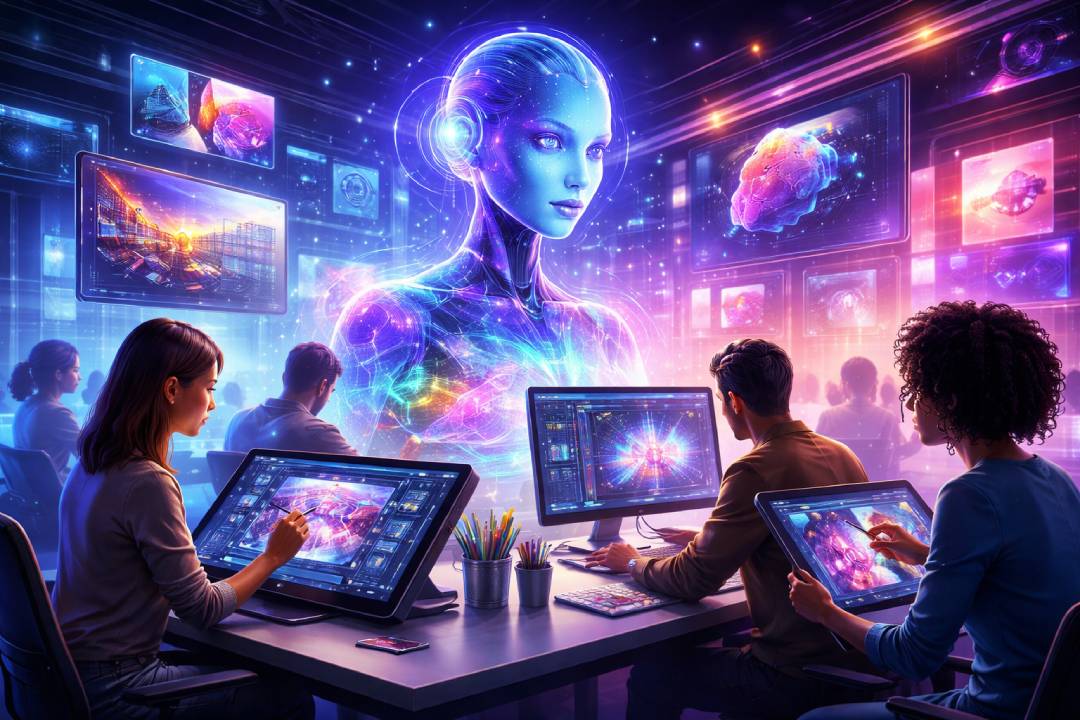
Mayumiotero – AI-Assisted Design is no longer a futuristic concept in 2026 instead, it has become an everyday companion for designers across industries. From graphic studios to product teams, creative workflows now blend human intuition with machine intelligence. As a result, designers spend less time on repetitive tasks and more time on conceptual thinking. This shift feels natural rather than disruptive, because AI tools quietly work in the background. In practice, many creatives describe AI as a “silent partner” that accelerates ideas without stealing authorship. Personally, I see this evolution as a healthy balance, where technology supports creativity instead of replacing it. Consequently, the creative process feels faster, lighter, and more experimental, which aligns well with modern design demands.
“Read Also: AI “Slop” Is Flooding Social Media and Users Are Starting to Push Back“
How AI-Assisted Design Accelerates the Early Ideation Stage
AI-Assisted Design has transformed ideation by shortening the distance between imagination and execution. Instead of starting with a blank canvas, designers can now explore dozens of visual directions in minutes. For example, AI-generated mood boards help teams test color palettes and layouts before committing resources. As a result, brainstorming sessions feel more dynamic and inclusive. From my experience, this reduces creative anxiety, especially for junior designers. Moreover, AI suggestions often spark unexpected ideas, pushing teams beyond familiar patterns. Therefore, ideation becomes a collaborative dialogue between human taste and algorithmic exploration.
How AI-Assisted Design Improves Efficiency Without Sacrificing Quality
AI-Assisted Design tools excel at handling repetitive production tasks that once consumed hours. Tasks like resizing assets, adjusting layouts, or generating variations are now automated with precision. Consequently, designers can focus on refinement rather than routine work. Importantly, quality does not decline; instead, consistency often improves. In my view, this efficiency shift elevates design standards across teams. While some feared automation would dilute craftsmanship, the opposite has happened. Designers now have more time to perfect details, which strengthens the final output.
How AI-Assisted Design Enhances Human Creativity Rather Than Replacing It
AI-Assisted Design works best as an amplifier of human creativity, not a substitute. While AI can generate options, humans still make aesthetic and ethical decisions. This distinction matters because creativity is deeply contextual and emotional. For instance, branding projects still rely on human empathy and cultural understanding. From an E-E-A-T perspective, this reinforces trust in human-led design. Therefore, AI becomes a tool that expands creative reach while preserving authenticity. I believe this synergy defines modern creativity.
How AI-Assisted Design Is Reshaping Collaboration in Creative Teams
AI-Assisted Design has quietly changed how creative teams collaborate. Shared AI tools create a common visual language, making feedback more concrete. Instead of abstract discussions, teams can review AI-generated prototypes together. As a result, decision-making becomes faster and clearer. In practice, this reduces miscommunication between designers, marketers, and stakeholders. From my observation, collaboration feels more transparent and less hierarchical. Consequently, creativity becomes a shared responsibility rather than an isolated role.
How AI-Assisted Design Supports Data-Informed Creative Decisions
AI-Assisted Design increasingly integrates data insights into creative choices. Tools now analyze user behavior, engagement metrics, and trends to guide design directions. However, this does not eliminate intuition; instead, it complements it. Designers can validate ideas with data while maintaining artistic judgment. Personally, I find this balance empowering rather than restrictive. By combining insight with instinct, creative outcomes feel both expressive and effective. Therefore, design decisions become more confident and defensible.
How AI-Assisted Design Raises Ethical and Authorship Questions
AI-Assisted Design also introduces ethical considerations that creatives must address thoughtfully. Questions about originality, bias, and authorship are now part of design discussions. While AI generates content, humans remain accountable for outcomes. From an authority standpoint, responsible use builds trust with clients and audiences. In my opinion, transparency is essential to maintain credibility. As a result, ethical awareness becomes a new creative skill, shaping professional standards in 2026.
How AI-Assisted Design Is Shaping the Future of Creative Careers
AI-Assisted Design is redefining creative career paths rather than eliminating them. Designers now evolve into creative directors, strategists, and curators of AI outputs. This shift rewards adaptability and continuous learning. From my experience, those who embrace AI gain a competitive edge. Consequently, creative careers feel more resilient and future-proof. Looking ahead, AI-assisted workflows will likely become a baseline skill, shaping how creativity is valued and practiced globally.