Mayumiotero – Foveated Rendering offers a smarter approach to creating demanding digital graphics. Instead of rendering every part of an image at maximum detail, the technique concentrates resources where visual detail matters most. Areas outside that region can receive less rendering detail. As a result, the system may reduce unnecessary graphics work while preserving the experience that matters to the viewer. The concept is especially relevant to virtual reality and mixed reality. These devices must deliver high-resolution images at stable frame rates while operating within strict performance limits. Therefore, simply increasing display resolution can create new computing challenges. Foveated Rendering approaches the problem from another direction. Rather than treating every pixel equally, it considers how people actually perceive a scene. This connection between human vision and computer graphics makes the technology particularly interesting. In my view, its greatest strength is not simply better performance. Instead, it represents a shift toward graphics systems that respond more intelligently to human perception.
Read Also: Nvidia RTX Pro 6000 Price Soars to $16,000 as AI Memory Demand Tightens Supply
Human Vision Provides the Inspiration Behind the Technology
The idea behind Foveated Rendering begins with the structure of the human eye. The retina contains a small central region called the fovea. This region supports our sharpest vision when we directly focus on an object. Meanwhile, peripheral vision covers a much wider area but provides less fine spatial detail. Consider reading a sentence on a screen. The words near your point of focus appear clear. However, text farther toward the edge of your vision becomes harder to read without moving your eyes. Foveated Rendering uses this characteristic as a design principle. The system can devote more graphics resources to the area where high detail is most useful. Meanwhile, peripheral areas may be rendered at reduced detail. Importantly, the transition must remain subtle. An aggressive reduction can become visible and distracting. Therefore, effective systems depend on careful control of resolution, shading, and image quality. This is why the technique combines knowledge from computer graphics with an understanding of visual perception.
Eye Tracking Can Move Detail with the Viewer
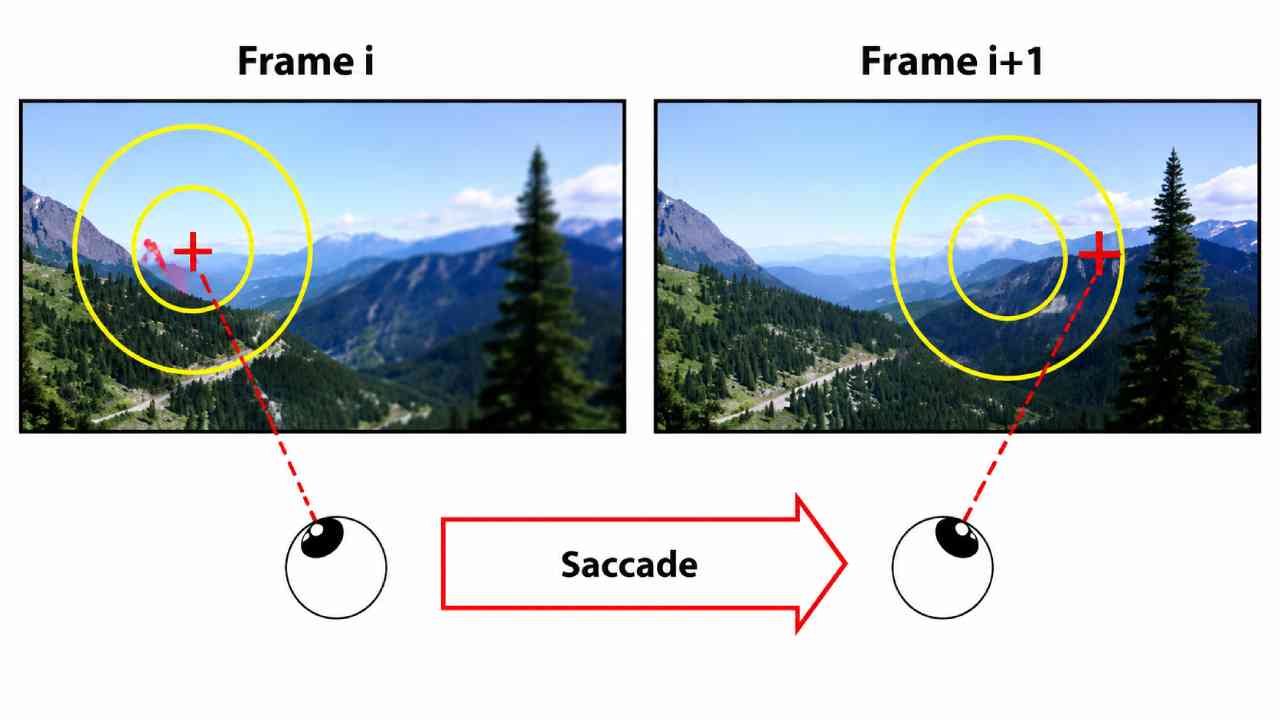
Dynamic Foveated Rendering becomes particularly powerful when paired with eye tracking. Sensors inside a headset estimate where the user is looking. The rendering system then adjusts the high-detail region to follow that gaze. Imagine exploring a virtual city. At first, you look toward a vehicle nearby. The system can prioritize detail around that vehicle. A moment later, your eyes move toward a distant building. The high-quality rendering region can then shift toward the new point of attention. Ideally, this process happens so quickly that the transition remains unnoticed. However, that requires accurate tracking and low latency. If the system reacts too slowly, the viewer may briefly notice a blurry region after moving their eyes. Therefore, eye tracking is not merely an additional feature. It can become part of the rendering pipeline itself. This connection allows the graphics engine to respond continuously to the user’s visual attention.
Fixed Foveated Rendering Works Without Tracking the Eyes
Not every implementation needs to know exactly where someone is looking. Fixed Foveated Rendering, often shortened to FFR, keeps the highest rendering quality around a predetermined area of the image. In many cases, that region sits near the center of the display. Detail then decreases toward the outer areas. This approach is simpler because it does not require real-time gaze information. As a result, it can be useful on hardware without integrated eye tracking. However, fixed rendering has an obvious limitation. People can move their eyes without turning their heads. Therefore, a user may look toward the edge of the display and notice reduced visual quality. Dynamic eye-tracked methods can address this problem by moving the detailed region with the gaze. Nevertheless, fixed techniques remain useful when developers need predictable performance savings. The choice between fixed and dynamic approaches ultimately depends on hardware, software, latency requirements, and the visual experience an application wants to create.
VR Headsets Face an Enormous Rendering Challenge
Virtual reality creates unusually demanding conditions for graphics hardware. A headset needs to present convincing images across a wide field of view. It must also maintain smooth motion because unstable performance can reduce comfort. Meanwhile, display resolutions continue to rise. Higher pixel counts can improve clarity, but they also increase the amount of work required from the graphics processor. Rendering every visible pixel at maximum quality can therefore become expensive. This challenge becomes even more significant when applications use detailed geometry, complex lighting, high-resolution textures, and advanced effects. Foveated Rendering can help by reducing work in areas where maximum detail provides less perceptual benefit. The saved resources can potentially support higher frame rates or additional visual effects. They may also help developers target demanding applications on hardware with tighter power limits. However, the actual benefit varies by implementation. Rendering engines, display resolution, tracking accuracy, and content complexity all influence the result. Therefore, foveation should be viewed as an optimization technique rather than a universal performance guarantee.
GPU Resources Can Be Used More Selectively
Modern graphics processors perform enormous amounts of work to build each frame. They calculate geometry, shading, textures, lighting, and many other visual elements. Yet a viewer does not perceive every part of that frame with identical sharpness. This creates an opportunity for more selective resource allocation. With Foveated Rendering, developers can reduce shading rates or image quality outside the important visual region. As a result, the GPU may avoid performing the most expensive operations uniformly across the display. The available performance budget can then be used elsewhere. For example, developers might increase detail around the gaze point or maintain a more stable frame rate. However, performance gains depend heavily on the rendering pipeline. Some workloads benefit more than others. In addition, developers must prevent quality differences from becoming obvious. The best implementation is not necessarily the one that reduces the most work. Instead, it is the one that finds an effective balance between computational savings and consistent visual quality.
Rapid Eye Movements Create a Difficult Technical Problem
Human eyes do not move slowly from one object to another. They frequently make rapid movements known as saccades. These movements create a challenge for gaze-responsive rendering. The eye tracker must detect a new direction quickly. Then, the rendering system must update the detailed region with minimal delay. If the process takes too long, the user’s gaze may reach a low-detail area before the renderer catches up. The result could be a brief but noticeable blur. Therefore, latency becomes a critical part of the experience. Prediction can also play a role. A system may use gaze behavior and motion data to improve how quickly it responds. However, prediction must remain accurate enough to avoid moving detail to the wrong location. Furthermore, developers need smooth transitions between quality levels. A visible circular boundary around the gaze point would immediately reveal the technique. Consequently, successful foveation depends on more than raw GPU performance. Tracking, display timing, rendering software, and perceptual design must work together.
Variable Rate Shading Can Support Smarter Rendering
One technology that can complement Foveated Rendering is Variable Rate Shading, commonly known as VRS. Traditional rendering may apply similar shading work across large parts of an image. VRS allows developers to vary the shading rate across different regions. This means important areas can receive more detailed shading, while less critical areas receive fewer shading calculations. The concept aligns naturally with foveation. A region around the gaze point can use a higher shading rate. Meanwhile, peripheral regions may use lower rates. However, Foveated Rendering and VRS are not identical terms. Foveated Rendering describes a broader perceptual strategy. VRS is one hardware and software technique that can help implement selective rendering. Other methods may adjust resolution, image reconstruction, or different stages of the graphics pipeline. Understanding this distinction is useful because the technology is not tied to one specific implementation. As graphics hardware evolves, developers can combine several techniques to achieve a similar perceptual goal.
The Benefits Extend Beyond Virtual Reality Gaming
Gaming may be an obvious use case, but Foveated Rendering has broader potential. Professional visualization can involve extremely detailed three-dimensional models. Architects may inspect complex buildings in immersive environments. Engineers can explore virtual prototypes. Meanwhile, training applications may simulate aircraft, industrial equipment, or specialized workplaces. In these situations, rendering performance can become a limiting factor. Selective detail could help allocate computing resources toward whatever the user is currently examining. The same principle may also support digital twins and immersive scientific visualization. However, professional environments often require high visual accuracy. Therefore, developers must be cautious when reducing detail. A peripheral object might still contain important information. The optimization strategy should match the task rather than simply maximize performance. This illustrates a broader point about visual technology. Efficiency is useful only when it preserves the information people actually need. Foveated Rendering works best when developers understand both the technical system and the behavior of its users.
Read Also: Parametric Design Turns Mathematical Rules Into Extraordinary Organic Forms
Higher-Resolution Displays Make Foveation More Relevant
Display technology continues moving toward greater pixel density and improved visual clarity. For immersive devices, this progression is particularly important because displays sit close to the user’s eyes. Higher resolution can make text easier to read and reduce visible pixel structure. However, every increase in resolution creates additional rendering demand. Simply pairing increasingly dense displays with increasingly powerful GPUs may not always be practical. Power consumption, heat, device size, and battery life can impose limits. Therefore, smarter rendering techniques become more valuable as hardware improves. Foveated Rendering offers one possible way to address this challenge. Rather than generating maximum detail everywhere, a system can prioritize the region where the viewer can perceive it most clearly. Over time, this approach may become increasingly sophisticated. Better eye trackers, faster displays, improved graphics APIs, and stronger prediction models can all contribute. The result could be immersive devices that deliver greater perceived clarity without requiring an equal increase in computational work across the entire frame.
Good Foveated Rendering Should Be Difficult to Notice
One of the interesting qualities of this technology is that success can make it almost invisible. Users should notice a sharp and responsive virtual world, not the optimization happening behind it. If someone clearly sees peripheral resolution changing, the implementation may be too aggressive or too slow. Therefore, developers must consider more than benchmark numbers. Human perception becomes part of the performance equation. The size of the high-detail region matters. So does the rate at which image quality falls toward the edges. Tracking accuracy, lens characteristics, display resolution, and application content also affect the experience. For example, text and fine geometric patterns may reveal quality changes more easily than simple surfaces. As a result, developers may need different settings for different applications. This makes Foveated Rendering a fascinating intersection between engineering and perception. The goal is not merely to draw fewer pixels. It is to decide where computational effort creates the greatest visible benefit.
Foveated Rendering Points Toward More Perceptive Graphics
The long-term importance of Foveated Rendering may extend beyond today’s VR headsets. The technique demonstrates how future computers can adapt visual processing to human attention. Instead of treating the display as a uniform grid, graphics systems can become aware of what the viewer is actually examining. That principle could influence mixed reality, professional simulation, spatial interfaces, and other immersive technologies. At the same time, challenges remain. Eye tracking must be accurate, latency must stay low, and transitions need to remain visually smooth. Developers must also ensure that optimization does not remove details users need. Nevertheless, the underlying idea is compelling. Future visual systems may not achieve efficiency through raw computing power alone. They may also become better at understanding where that power matters. In my view, this is what makes Foveated Rendering significant. It connects graphics hardware, software, optics, and human perception. Ultimately, sharper graphics may come not only from rendering more, but from rendering more intelligently.